
 Lachlan Brown
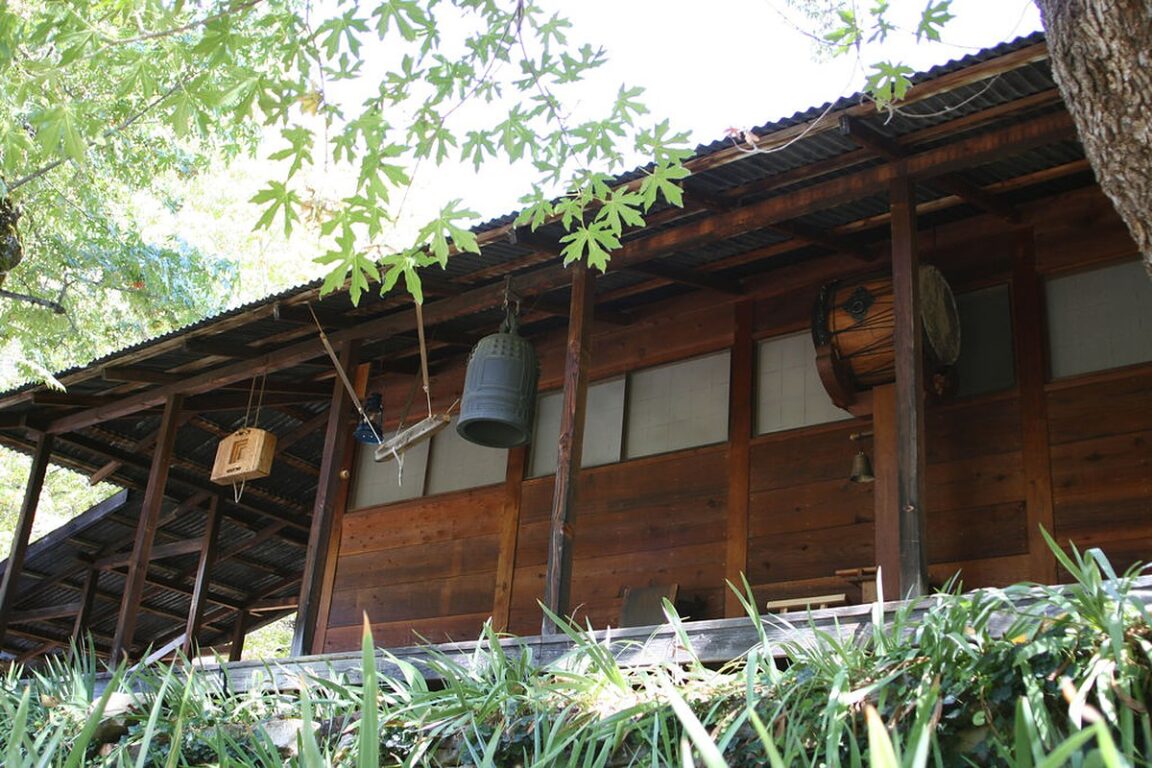
Late on the night of March 26, a fire destroyed the zendo at Tassajara Zen Mountain Center in California’s Ventana Wilderness. San Francisco Zen Center’s account says no one was injured and the 1978 structure was lost. Some ceremonial instruments had been moved to safety, while the 2,000-year-old Gandharan Buddha statue, also moved near the library, cracked and crumbled; its head remained intact.
Here is what makes the timing almost impossibly poetic: the community at Tassajara was in the final stretch of a three-month practice period, a cloistered, mostly silent retreat. The theme they had been sitting with, day after day, for weeks? Impermanence.
I don’t know how you respond to a detail like that. I sat with it for a while myself. And I kept coming back to the same thought. Not sympathy, though I felt that. Not irony, though there’s certainly some. What I kept thinking was: this is what Buddhist practice is actually for. Not the quiet mornings. Not the beautiful halls. This.
When I found Buddhism, I wasn’t looking for a religion. I was looking for something that made sense of the fact that everything felt uncertain and slightly out of control. The teachings I came across talked about impermanence the way most people talk about gravity. Not as something to fear or resist, but as the basic condition of being alive. Things arise. Things pass away. Your job isn’t to stop that process. Your job is to stop pretending it isn’t happening.
That idea lodged somewhere in me and never left. But understanding it intellectually and living it are entirely different things. I know this because I’ve spent years learning the difference.
There’s a version of Buddhist practice that stays safely in the realm of ideas. You read the books. You nod along with the teachings. You find impermanence philosophically interesting. You might even sit on a cushion for twenty minutes each morning and feel a pleasant sense of calm. None of this is bad. But none of it is the thing itself.
The thing itself is what happens when the zendo burns down.
Or, in less dramatic terms: when the plan falls apart. When the relationship ends. When the test comes back wrong. When you’re standing in a warehouse in Melbourne at 6 AM, stacking televisions, and the gap between your psychology qualification and your actual life feels unbridgeable. That was my version of the fire. Smaller, quieter, nobody wrote a news article about it. But it burned down something I’d been sitting inside of, namely the belief that if I just did everything right, things would work out the way I expected.
They didn’t. And the Buddhism I’d read about was suddenly not a philosophy anymore. It was the only framework I had for making sense of what was happening.
I think this is the part that gets lost in how mindfulness and Buddhism are often presented, including, honestly, by people like me who write about it for a living. We talk about presence and calm and letting go as if they’re lifestyle upgrades. As if Buddhism is a nicer way to handle your to-do list. And sometimes it is. My daily meditation practice, whether it’s five minutes or thirty, does help me manage stress and stay focused. That’s true.
But that’s not what it’s for. Or rather, that’s the training wheels version. The real practice is for the fire.
The monks at Tassajara didn’t just sit and watch the building burn. They fought it. Staff and residents, led by their abbot, who had helped save Tassajara from the 2008 Basin Complex fire, hauled buckets of water from the creek and used hoses and irrigation spigots to contain the blaze, saving dozens of surrounding structures. The local fire department praised their response. This is important because there’s a lazy caricature of Buddhist practice that says it’s about passive acceptance, about sitting cross-legged while the world falls apart and saying “everything is impermanent” with a serene smile.
That’s not what happened at Tassajara. What happened was that people who had spent months practicing awareness, attention, and equanimity responded to a crisis with clarity and coordinated action. They did what needed to be done. And then, when the building was gone, they sat with the loss.
Both parts matter. The doing and the sitting with. Buddhism isn’t just about accepting what happens. It’s about responding to what happens without being overwhelmed by your own reactions to it. Acting clearly in the middle of chaos, then being honest about the grief afterward, without turning away from either one.
I think about this in my own life, which is considerably less dramatic than a monastery fire but is still, on any given day, full of small losses and disruptions. The ordinary kind. A small child wakes at 3 AM and the plan for a productive morning evaporates. A piece of writing that took days turns out to be heading in the wrong direction. A conversation at work gets tense before everyone finds their way back.
None of these are tragedies. But each one is a tiny zendo fire. A moment where the thing I was counting on, the structure I’d built in my mind about how things should go, meets reality. And in that moment, I either practice what I’ve learned, or I don’t.
Mostly, I practice imperfectly. I get frustrated. I resist. I spend ten minutes wishing the situation were different before I remember that wishing doesn’t change anything. But then, eventually, I remember. And that remembering, that turning back toward what’s actually happening instead of what I wanted to be happening, is the practice. Not the cushion. Not the zendo. The remembering.
There is a detail from the Tassajara fire that I have not been able to stop thinking about. The 2,000-year-old Gandharan Buddha statue had been damaged in the 1978 zendo fire and restored by the Asian Art Museum. During the 2008 Basin Complex fire it was buried for protection and survived. In the 2026 fire it was moved near the library, where it cracked and crumbled, although its head remained intact.
Two thousand years. Civilizations rising and falling. The statue travelling from the Indian subcontinent to a mountain valley in California. Surviving centuries, restoration after one fire, and protection during another. Then being severely damaged in the next.
If that’s not a teaching on impermanence, I don’t know what is. And it’s a teaching that doesn’t come from a book or a lecture or a guided meditation. It comes from the thing itself happening.
I run most mornings, whatever the weather. Sometimes it’s pleasant. Often it’s not. That’s part of why I do it. Not because I enjoy suffering, but because learning to stay present with discomfort, to keep going when every part of you wants to stop, is practice for the moments when the discomfort isn’t optional.
Those Tassajara monks didn’t become calm and capable in the middle of a fire by accident. They became that way through years of showing up, day after day, to a practice that can feel pointless on any given morning. Sitting still. Paying attention. Noticing the impulse to get up, or check your phone, or drift into planning, and choosing to stay with what’s here instead. It looks like nothing. But it builds something invisible, a capacity to meet reality without flinching.
I don’t live in a monastery. I live in the ordinary world, with a daughter, a business, and a coffee habit. My version of practice is messy. It happens in five-minute gaps between meetings, on morning runs, in the few quiet moments after my daughter finally falls asleep and before I do too. It is not photogenic.
But I think that’s the point. The teachings were never meant to live in beautiful buildings. They were meant to live in us. In the way we respond when the fire comes, whether that fire is a literal blaze consuming a meditation hall or the quiet collapse of something we were counting on. The practice is not the building. The practice is what remains when the building is gone.
Correction (14 September 2026): An earlier version incorrectly said a century-old bell and the Gandharan Buddha were buried in the rubble and that the statue had survived the 1978 fire intact. San Francisco Zen Center reports that some instruments were saved, the statue was restored after damage in 1978, and its head survived the 2026 fire.
Feature image: The zendo at Tassajara by Bradley Allen, via Wikimedia Commons, licensed under CC BY-SA 2.0 (resized).
Did you like my article? Like me on Facebook to see more articles like this in your feed.


.jpg)