Hack Spirit Editorial Team
Every generation thinks the one before it was reckless. The 70s make that case easier than most.
What’s striking in hindsight is how often these things were treated as ordinary or went publicly unchallenged, even though awareness and attitudes varied at the time.
Here are seven of them, the kind that make anyone under forty pause for a second.
1. Children rode loose in cars
Standing up between the front seats. Lying flat in the back of an estate car with the seats folded down. Three kids in a footwell on a motorway.
Seatbelts existed, but they were often tucked into the crease of the seat and left there. Many adults treated that as ordinary.
The car seat as we know it barely registered. A baby travelled in someone’s arms in the front, and that was considered a perfectly sensible arrangement because the person holding them was being careful.
Ask anyone who lived through it and they’ll describe the back of the estate car fondly. It was the best seat in the vehicle.
2. Smoking indoors, everywhere, all the time
Offices. Aeroplanes. Cinemas. Restaurants without a section, because there was nothing to have a section from.
Hospitals had ashtrays in the waiting rooms. Doctors smoked while talking to patients. There were ashtrays built into the armrests of trains and the seatbacks of coaches, which is a detail that sounds invented until you see one.
Smoking remained socially accepted in many indoor settings, but the health risks were not unknown. The 1964 U.S. Surgeon General report had already publicised strong links between smoking and disease, and the 1972 report reviewed public exposure to air pollution from tobacco smoke. What lagged was broad protection from other people’s smoke.
3. Gone until the streetlights came on
A child left the house after breakfast on a Saturday and returned at dusk. No phone, no check-in, no stated destination.
Many parents did not know exactly where their children were for hours at a stretch, and in some communities this was treated as a normal arrangement rather than neglect.
The rules were geographic rather than temporal. Don’t cross the main road. Be back when the lights come on.
What’s hard to convey now is how little visible worry some families attached to it. Often there was no formal decision; the freedom was simply part of local expectations.
4. The hitchhiker on the roundabout
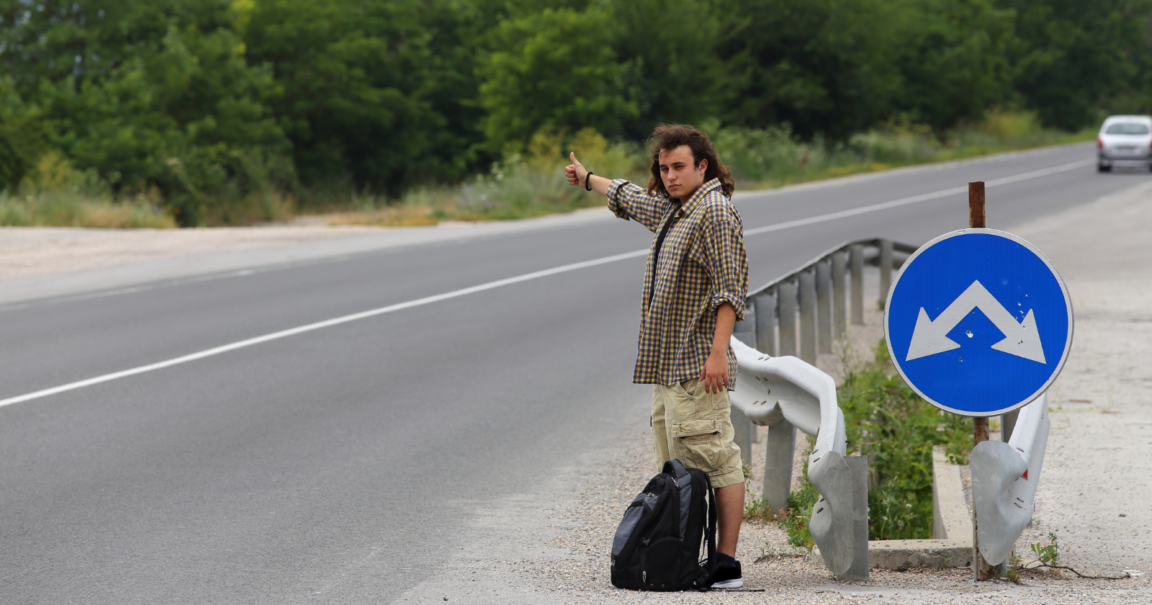
Thumb out, rucksack, sign with a town name written in marker. Students did it to get home for term. Soldiers did it in uniform. People hitched to festivals and job interviews.
Drivers stopped. Not always, but often enough that it was a functioning transport system rather than a gamble.
There’s a whole vocabulary attached to it that’s fallen out of use. Good spots to stand. Which roads were reliable.
The practice died out rather than being banned. As perceptions of risk and transport habits changed, the practice became much less common without one clear moment marking the shift.
5. Deliberately burning yourself in the sun
Baby oil. Tin foil reflectors. Lying out at midday specifically because that was when it worked fastest.
Sunscreen was for children with fair skin, and even then it was factor four. Higher numbers were viewed as defeating the purpose.
Peeling was a normal August event, discussed openly, sometimes competitively. A bad burn was the price of a good tan and the tan was the point.
The advice ran in the opposite direction to now. Build up a base first. Get a bit of colour early so you don’t catch it later.
Whole holidays were organised around it.
6. When the school handled discipline on its own terms
A child got in trouble at school and the parents heard about it afterwards, if at all. There was no email, no meeting, no discussion of approach.
Corporal punishment remained legal in many school systems, although laws and use varied by place and teacher.
The part that seems most foreign now is the parental response. In some communities, parents were less likely to challenge the school and more likely to assume that a punished child had earned it.
Parents and teachers weren’t in partnership. They were in a chain of command, and the child was at the bottom of it.
7. Being genuinely unreachable
You left the house and that was that. Nobody could contact you and you couldn’t contact anyone until you found a phone box with change in your pocket.
Arrangements had to be made in advance and honoured exactly, because there was no mechanism for adjusting them. Six o’clock outside the cinema meant six o’clock outside the cinema.
People waited. If someone was late you had no information at all, just standing and guessing.
And the phone at home was one object in one place, usually in a cold hallway, with a cord that reached about four feet. Every conversation happened where the whole family could hear it.
Teenagers stretched that cord to breaking point for a decade.
Most of these changed for good reasons and nobody sensible wants the seatbelts back in the seat crease. Still, it’s striking how completely the water we swim in gets replaced without anyone announcing it.
If you’ve got someone in your life who was an adult then, ask them about it sometime. They’ll usually be surprised you find it interesting, which is its own small piece of information.
Correction (14 September 2026): An earlier version wrongly implied that nobody in the 1970s connected smoking or smoke exposure with harm. The section now acknowledges the public health evidence and official warnings already available at the time.